Black Radio | The Voice of The People:
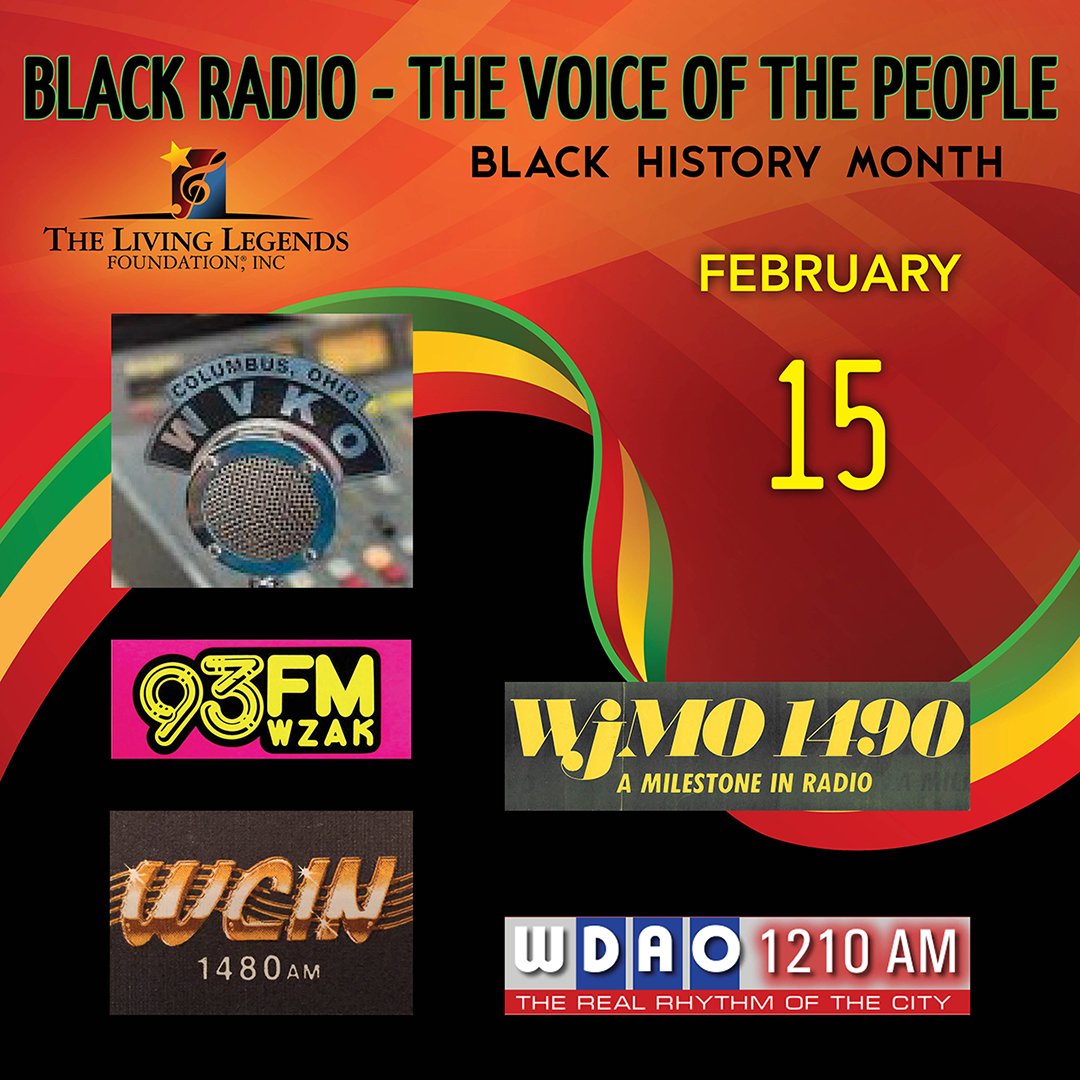
Today, the Living Legends Foundation celebrates Ohio, paying tribute to the Black radio stations that helped define & elevate the culture.
Cleveland’s WJMO began at 1490 AM and became one of the first stations in that market to commit to a Black oriented R&B format. The station’s impact is inseparable from its on-air personalities, especially Lynn Tolliver Jr., whose presence helped define what classic Black R&B radio felt like in the city. Other local voices rotated through the lineup over the years, many of them becoming staples not only at WJMO but at related outlets such as WABQ, creating a tight circle of recognizable talent that Cleveland listeners followed from frequency to frequency. Legendary group, The O’Jays were named after WABQ DJ Eddie O’Jay.
WZAK started in 1963 as an ethnic outlet, but its defining moment came in 1981 when it flipped to urban contemporary as “Rhythm Radio 93FM WZAK, The Rhythm of Cleveland,” and then hit the gas. Under the programming direction of Lynn Tolliver Jr., who also had a top morning show with Ralph Poole, “Tolliver & Poole”, the station assembled a strong airstaff that blended personality, polish, and street credibility.
Cincinnati’s WCIN 1480 AM is remembered as the city’s first full time Black oriented station when it signed on in 1953. It delivered R&B, gospel, and news for Black Cincinnati with an urgency that felt local, not imported. Air personalities such as Lincoln Ware, who would later become a major talk voice in the market, helped turn the station into a daily meeting place. Other longtime jocks and news voices built reputations that stretched beyond music, shaping conversations about politics, schools & civil rights inside the city.
If WCIN was the foundation, WIZF was the expansion. From its early urban contemporary days through later eras under Radio One, The Wiz built a lineup of energetic personalities who connected deeply with younger listeners. Over time, even as ownership shifted, WIZF’s DJs remained the heartbeat of the brand.
In Columbus, WVKO became a kind of front porch for central Ohio’s Black community, first at 1580 AM and later with an FM presence that carried its reach and its reputation. By the early 1960s it had grown into the city’s premier soul and R&B outlet, built on a steady rhythm of sermons, gospel, neighborhood notices. Voices like James “Eddie” Saunders and Kirk Bishop helped define that sound, while personalities and local jocks gave the station a tone that felt intimate and immediate. Later, the AM signal cycled through progressive talk and then Catholic programming under St. Gabriel Radio.
In Dayton, WDAO 1210 AM is widely recognized as the Miami Valley’s first and only Black owned station after Johnson Communications acquired it in 1987 and aimed the signal directly at the region’s Black community. Its roots stretch back to earlier figures like Gene “By Golly” Barry, whose presence helped shape the identity of Black radio in the city and laid the groundwork for WDAO’s later direction. Over the years, the station’s announcers balanced music with strong community talk, delivering R&B, blues, gospel & public service programming in equal measure as “The Real Rhythm Of The City”.
WROU (92.1 FM) was founded in 1991 by Ro Nita Hawes-Saunders, an educator and dancer who had previously worked as an on-air personality at WDAO. Initially operating as a mainstream urban station, it was acquired in 2003 by Radio One, which subsequently shifted the format to urban adult contemporary. Notable programmers over the years included Stan Boston and Marco Simmons.
If you have memories of these or other stations in Ohio, please add them in the comments.
#VoiceOfThePeople #BlackHistory #LivingLegends #BlackRadio #LLF #BlackHistoryMonth