Black Radio | The Voice of The People:
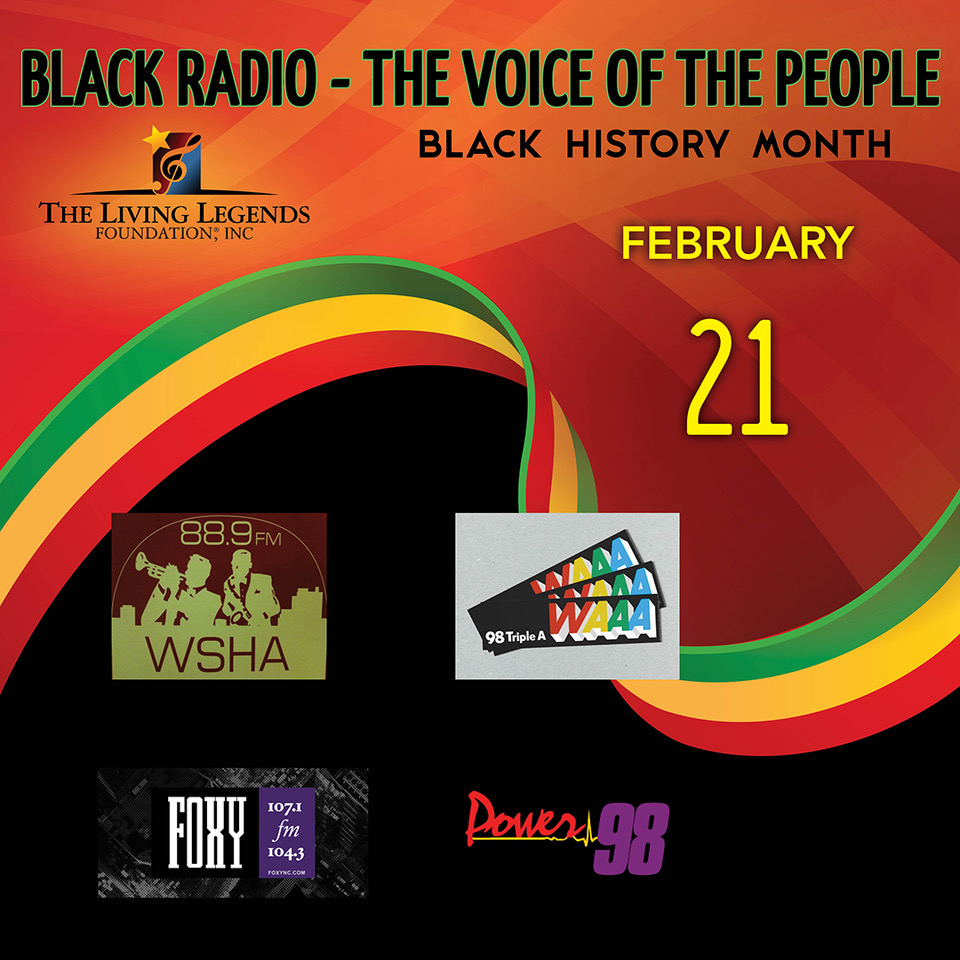
Today, the Living Legends Foundation celebrates North Carolina, paying tribute to the Black radio stations that helped define & elevate the culture.
In Charlotte, WGIV 1600 AM signed on in 1947 as the city’s first station to program full-time for Black audiences. Blending R&B, gospel, and community affairs, WGIV was distinctive for its integrated staff at a time of deep segregation. Personalities such as Chattie Hattie Leeper, Pete “Hound Dawg” Toomey, Eugene “Genial Gene” Potts, and Ray Gooding, Slack “Slick Slack Johnson and Manny Clark helped define its sound. Slack Johnson and Manny Clark would go on to have notable careers as music label executives.
White owner Francis Marion Fitzgerald publicly championed racial unity, symbolized by the station’s logo of Black and white hands clasped in a handshake. Beyond symbolism, WGIV invested in empowerment—broadcasting live from the legendary Excelsior Club, partnering with Carver College for business training initiatives, and advocating for civil rights alongside Charlotte powerhouse WBT. The station earned praise from local churches for fair coverage and made history by employing one of the South’s first Black radio engineers, Uriah Gooding.
By the late 1960s, rising Black Power consciousness led some activists to question white ownership of Black-formatted stations. In 1982, Suburban Radio Group acquired WGIV and shifted much of its urban audience to FM sister station WPEG. WGIV experimented with formats before signing off on December 3, 2003, after more than 55 years. The WGIV calls were revived in 2005 at 740 AM in Pineville, later evolving into urban gospel and, by 2014, mainstream urban branding as “Streetz 103.3.” Programmers over the years included Don Cody, Vinny Brown, and Tony Gray.
Meanwhile, WPEG 97.9 FM, “Power 98,” became Charlotte’s dominant mainstream urban voice. Originally launched in Concord in 1961 as WEGO-FM, the station adopted the WPEG calls in 1967 and transitioned from beautiful music to a “Super Soul” format in 1978. By 1982, after absorbing much of WGIV-AM’s audience and programming influence, WPEG was solidified as Charlotte’s heritage urban station. Through multiple ownership changes, Power 98 has remained a market leader in R&B and hip-hop. Programmers include Michael Sanders, Andre Carson, Jeff “Uzi D” Anderson, Terri Avery, Jamillah Muhammad & Brian “Mr. Incognito” Robinson. Talent included Skip Murphy, BJ Murphy, Keith Richards, Barbara Taylor, Helen Little, Frankie Darcell, Derrick “DC” Corbett, Kevin “Koolin” Fox and the late Nate Quick.
WBAV-FM 101.9 FM, “V 101.9” served the Charlotte metro area starting in 1947. Owned by the Beasley Broadcast Group, it carries an urban adult contemporary format, from 1994 & has been the home of the Tom Joyner morning show & The Steve Harvey Morning Show. Programmers included Jeff “Uzi D” Anderson, Terri Avery, Jamillah Muhammad.
In Raleigh, WSHA signed on in 1968, owned by Shaw University & would become the Raleigh Durham’s first 24 hour black formatted and owned FM station. Among the early staffers were Andre Perry, Phyllis Reese & J.C. Futrell In 1982 David Linton became GM/PD and assembled a team that included notably Gary Mayo, Cathis Hall, B.J Murphy, Chris Connors, Tim Greene and others. In 2018, Shaw sold the license to Educational Media Foundation, & the station became WRKV under the K-Love Contemporary Christian format. Shaw preserved its legacy through online streaming as WSHA 89.9 and through the HBCU Radio Preservation Project that is working to digitize historic recordings of civil rights leaders and local events.
WLLE Soul 57 was Raleigh’s perennial commercial R&B Station featuring such notables talents such as Paul Engram’s (Showgram), “Sweet Bob” Rogers, J.C.Futrell, J. Willie Moore, Charles Harrison, Cuba Gooding, Rich High and “Big” Bill Haywood would go on to a career in the record industry, The station’s Gospel Show hosted by Brother James Thomas leader of the city’s most popular singing groups. The station became black owned when it was acquired by the Carolinian Newspaper. The station afforded many of the Shaw University’s students their first jobs.
WQOK 97.5 FM “K-Power97.5” in Raleigh is owned and operated by Urban One and airs a hip hop-leaning urban contemporary radio format. In 1989, Joyner sold the station to Four Chiefs, Inc., owned by Ragan Henry, who then sold it to iHeart in 1996.
Notable PDs were Vinny Brown, Cy Young, Hozie Mack & Derrick Baker.
In Durham, WSRC 1410 AM “The Source” launched in 1954 as North Carolina’s first “Negro-oriented” station. Despite its debut broadcast being disrupted by Hurricane Hazel, WSRC quickly became a cultural force, elevating local R&B and soul artists while shaping Black political discourse. DJs such as Norfley Whitted, Jimmy “Dr. Jive” Byrd, and Ervin Hester built loyal audiences. The station was owned at one time by C. Warren Massenburg and former broadcaster at WLLE. The station’s influence even reached the art world—its call letters appear in North Carolina native Ernie Barnes’ iconic painting “Sugar Shack.” WSRC transitioned to full gospel WRJD “Rejoice 1410”.
In 1979, WDUR 1490 in Durham became the market’s first 24 hour commercial AM station that could be heard in both Raleigh and Durham clearly. It was programmed by Alvin (AC) Stowe, who later became a part owner when the company purchased and launched Urban WFXC (Foxy 107.1) Foxy 107.1 became the market’s first 24 hour “Commercial” black formatted FM station. Later owners expanded the stations reach with translators (WFXK 104.3 FM), Acquired by Urban One in 2000, Foxy solidified its presence through music, community events, and cultural engagement. Past Programmers include Cy Young, Chris Conners and Jodi Berry.
In rural North Carolina, WVOE 1590 AM—“The Voice of Ebony”—made history in 1962 as the state’s first Black-owned station in rural America. Founded by T.M. “Ted” Reynolds and investors under Ebony Enterprises, WVOE offered gospel, R&B, blues, jazz, community news, and live choir broadcasts. It remains the oldest continuously operating African American-owned station in the South. Facing severe financial challenges in 2019, the station survived through community crowdfunding and continues today with gospel and urban adult contemporary programming.
WQMG (97.1 FM) signed on in Greensboro, NC in 1962 as the first station in the southeast to broadcast in FM stereo, with call letters standing for “Where Quality Music lives in Greensboro”. It has maintained a long history as a key local music station, currently featuring Adult R&B and Old School hits under Audacy. Key programmers for the station included Warren Epps, Sam Weaver, Terry Foxx, Brian Wallace, Jackson Brown, Al Payne and Alvin (AC) Stowe. Legendary air talent included BJ Murphy, Jasmine James, Tammy Mack, Africa Perry, CC Carter, Ernie C, Bobby Holiday, Skip Dillard, Derrick “DC” Corbett, Anjelique Perrin and Mic Foxx and was consulted by Tony Gray.
WJMH (102.1 FM) branded as “102 JAMZ” is a long-standing urban-leaning rhythmic contemporary station in the Greensboro/Piedmont Triad area. Founded in 1947 by Reidsville Broadcasting Company, it evolved through several formats and owners before launching its signature hip-hop format in December 1988. Personalities over the years have included Shilynne Cole, Busta Brown, Madd Hatta, Kyle Santillian, Skip Dillard, Afrika Perry, Boogie D, Mary K, Kendall B, The Bushman, Big Tap Money. Other well-known personalities included Terrence J, broadcast “voice-over” talents George “Apollo” Fetherbay, Traci LaTrelle, Sammy Mack, Big Lip Bandit and The late Tre Black.
Winston-Salem’s WAAA, which signed on October 29, 1950, holds the distinction as North Carolina’s first fully Black-programmed station. Its original staff—led by Program Director Bernard Baker and announcers Lucille Douthit, Bruce Miller, and Larry Williams—offered gospel, jazz, R&B, news, sports, obituaries, and live Sunday church services. WAAA launched the careers of beloved personalities including Fred “Steady Eddie” Allen, Robert “Bobcat” Roundtree, and Oscar “Daddy-Oh” Alexander, whose “Daddy-Oh on the Patio” broadcasts from Ray’s Roadside Drive-In became community staples. In 1979, 26-year-old Mütter Evans purchased WAAA, becoming the youngest Black American and the second Black woman to own a U.S. radio station. She expanded community programming and organized Winston-Salem’s first local MLK Jr. birthday celebration in 1981 before selling the station in 2005 amid industry consolidation.
Also in Durham, WAFR “Wave Africa,” launched in 1971, rooted in Black Power philosophy, WAFR centered African music, jazz, funk, news from a Black perspective, Malcolm X recordings, and innovative programming such as the Community Radio
Workshop—a culturally grounded children’s show. Leaders including Robert Spruill, Obataiye Akinwole, Ralph Williams, Donald Baker, and Kwame and Mary McDonald served not only as broadcasters but as activists and educators.
In 1995, North Carolina Central University (HBCU) launched WNCU FM which today fills the void for Jazz lovers left when Shaw University sold WSHA.
Together, these stations ensured that Black voices in North Carolina were heard—clearly, powerfully, and unapologetically.
If you have memories of these or other stations in North Carolina, please add them in the comments.
#VoiceOfThePeople #BlackHistory #LivingLegends #BlackRadio #LLF #BlackHistoryMonth