Black Radio | The Voice of The People:
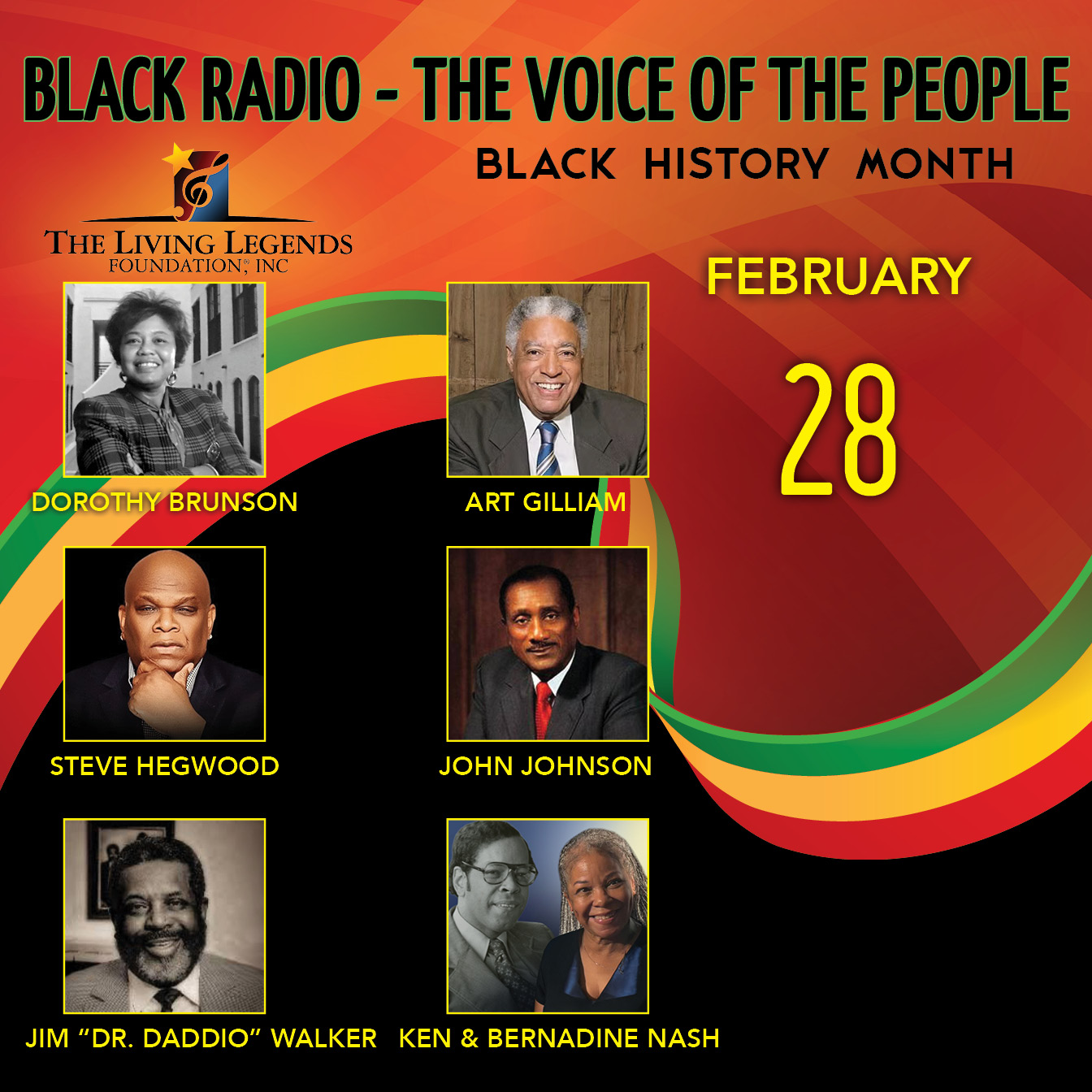
Today, the Living Legends Foundation pays tribute to the Black radio station owners who helped define & elevate the culture. This is part 6 of 6.
Dorothy Brunson was a pioneering broadcaster and media executive whose influence helped open doors for generations of women in radio.Her broadcasting career began in 1964 when Sonderling Broadcasting hired her as assistant controller at WWRL in New York. By the time she departed in 1969, she had risen to assistant general manager and corporate liaison to the company’s Board of Directors — a rare achievement for a Black woman in that era.
Brunson later co-founded Howard Sanders Advertising, recognized as the first Madison Avenue–style advertising agency dedicated to serving Black consumers. In 1972, she joined Inner City Broadcasting Corporation (ICBC) to assist investors who had acquired WLIB-AM. As general manager, she led efforts to reduce company debt and helped expand ownership to six additional stations.
Determined to build her own broadcast empire, Brunson purchased WEBB-AM (1360) in Baltimore from entertainer James Brown in 1979. She later acquired WIGO-AM in Atlanta and WBSM-AM in Wilmington, North Carolina. In 1990, she sold her radio holdings to finance the launch of WGTW-TV (Channel 45), licensed to Burlington, New Jersey. The station was eventually sold to Trinity Broadcasting Network in 2004.
In 1977, Art Gilliam purchased WLOK AM, making it the first locally Black-owned radio station in Memphis. As CEO of Gilliam Communications, he transitioned the station to an all-gospel format in 1985, transforming it into a top-rated and spiritually influential property.
Gilliam was a barrier-breaking journalist as well — becoming the first Black columnist at The Commercial Appeal and the first Black on-air reporter and anchor at Action News 5 in Memphis. Gilliam’s impact extended beyond programming — he built an institution that blended culture, journalism, and community empowerment.
Steve Hegwood transitioned from programming into ownership, becoming one of the most innovative figures in contemporary Black radio. Through Core Radio Group and Core Communications Broadcasting, he became known for leveraging underutilized FM signals to create highly competitive Urban stations. His Atlanta properties include Streetz 94.5 and 87.7 “The Vibe.” He expanded the Streetz brand into other markets including Albany, Georgia (WMRG 93.5), Norfolk, Virginia (WXTG 96.5), and Charlotte, North Carolina (WGIV 103.3/100.5).
In 2023, he launched a 24-hour hip-hop and lifestyle video network, StreetzTV, further extending the brand into multimedia. Earlier in his career, Hegwood served seven years as Vice President of Programming for Radio One (now Urban One).
Hegwood was honored as a Living Legend in 2019, inducted into the National Black Radio Hall of Fame in 2024 and the Friends of Georgia Black Radio Hall of Fame in 2025 — recognition of his forward-thinking leadership.
In the 1940s, John H. Johnson founded Johnson Publishing Company, the Chicago-based media empire that produced Ebony and Jet. At their height, the magazines reached millions of readers and were staples in Black households nationwide. Designed with the polish of Life and Look magazines, Ebony elevated the Black experience onto equal cultural footing.
Johnson expanded into broadcasting in 1973 with the purchase of WJPC-AM, Chicago’s first Black-owned radio station. Under Johnson Communications, the company later acquired WLOU-AM in Louisville (1982) and WLNR in Lansing, Michigan (1985).
Despite facing segregation and systemic racism, Johnson built a multimedia empire that celebrated Black achievement and beauty. Business executive Mellody Hobson and her husband, filmmaker George Lucas, successfully petitioned to secure the historic Ebony photo archives, preserving an irreplaceable cultural treasure.
Boston’s WILD was purchased by Sheridan Broadcasting Corporation in 1972 before being acquired in 1980 by Nash Communications, led by Kendall Nash. After Nash’s passing in 1992, his wife Bernadine Nash assumed leadership, continuing its legacy of community service. In 2000, Radio One entered a local marketing agreement that later became an outright purchase. Throughout its history, WILD served as an authoritative and trusted voice for Boston’s Black community.
James “Daddy-O” or “Dr. Daddio” Walker was a legendary broadcaster and entrepreneur who owned and operated KDKO 1510 AM, branded “The Soul of the Rockies.” The station became one of the nation’s most influential Black-owned outlets and the first Black-owned radio station west of Kansas City. Walker was a visionary who used radio to uplift culture, amplify community voices, and mentor generations of broadcasters and leaders. In 2008, he was inducted into the Blacks in Colorado Hall of Fame. His life story is chronicled in the biography Radio in My Soul: The Journey of James “Dr. Daddio” Walker, preserving the legacy of a man whose passion for broadcasting truly lived in his soul.
These pioneers did more than own stations — they built platforms of power, pride, and progress. Their courage, innovation, and commitment to community ensured that Black voices were not only heard, but sustained for generations.
These leaders carved out platforms that amplified Black voices and built institutions designed to endure.
If you have memories of these leaders, please add them in the comments.
#VoiceOfThePeople #BlackHistory #LivingLegends #BlackRadio #LLF #BlackHistoryMonth