Black Radio | The Voice of The People:
Celebrating Black Radio Station Owners (Part 2 of 6)
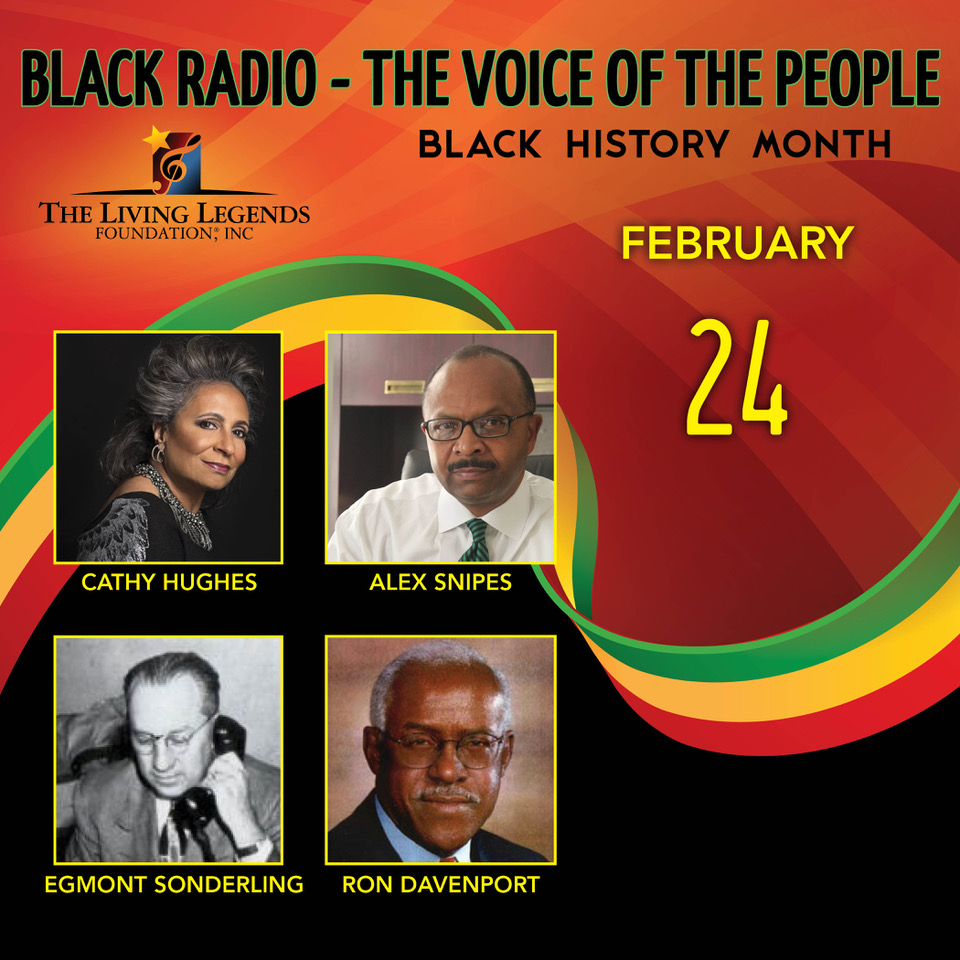
Today, the Living Legends Foundation pays tribute to the Black radio station owners who helped define & elevate the culture. This is part 2 of 6.
Cathy Hughes is widely celebrated as a visionary leader who built one of the most influential Black-owned media companies in America.
When she founded Radio One—now known as Urban One—she laid the foundation for a multimedia powerhouse that would reshape Black radio. In 1999, Hughes made history as the first Black woman to lead a publicly traded corporation.
Her journey began around 1980 with the purchase of WOL-AM in Washington, D.C. She transformed the struggling station into a thriving talk radio outlet, creating a blueprint for culturally relevant programming that spoke directly to Black audiences. That success became the launching pad for Radio One’s expansion. Today, Urban One owns more than 55 stations in 16 markets, including major outlets such as WKYS-FM, WHTA-FM, and WPHI-FM—cementing Hughes’ legacy as a pioneer in media ownership.
In Columbia, South Carolina, Alexander Snipe has built a powerful regional media presence as President and CEO of Glory Communications Inc., parent company of WFMV. In 2018, the company celebrated 25 years of service to the Columbia community. WFMV made history as the nation’s first 24-hour FM gospel station, setting a standard in faith-based broadcasting.
Under Snipe’s leadership, Glory Communications expanded to seven highly rated South Carolina stations, including WGCV and Millennial FM 105.1. In 2022, WFMV earned national recognition by winning the prestigious Marconi Award for Religious Station of the Year—an achievement that underscored the company’s excellence and enduring community impact.
Earlier pioneers also helped shape the sound and structure of urban radio. In January 1964, Egmont Sonderling purchased WWRL in New York and boldly shifted its format to R&B, helping define the genre’s presence on mainstream radio. The station’s air talent included future legends such as Frankie Crocker and Jocko Henderson.
Sonderling assembled an influential portfolio of stations, including WOPA, KDIA, WRVR-FM, WBMX, WDIA, and WOL AM/FM in Washington, D.C. Within this growing network, Jerry Boulding rose to the position of Vice President and National Program Director, becoming one of the most influential Black programmers in the country.
In Pittsburgh, Ron Davenport Sr. founded Sheridan Broadcasting Corporation (SBC) around 1972, building another cornerstone of Black-owned broadcasting. In 1979, Sheridan purchased the Mutual Black Network, merged it with the National Black Network, and rebranded the combined entity as American Urban Radio Networks (AURN). The network grew to include hundreds of affiliates nationwide, becoming one of the largest Black-owned radio networks in the United States.
Syndicated programming such as Tanya Hart’s Hollywood Live flourished on AURN, while pioneering journalist Ed Castleberry helped shape the news legacy of MBN. Sheridan’s owned stations included WAMO AM/FM and WGPR-AM, each playing a vital role in serving Black communities.
These leaders carved out platforms that amplified Black voices and built
institutions designed to endure.
If you have memories of these leaders, please add them in the comments.
#VoiceOfThePeople #BlackHistory #LivingLegends #BlackRadio #LLF
#BlackHistoryMonth